Corporate Europe Observatory

Exposing the power of corporate lobbying in the EU

Action in Brussels on GMO risk assessment meeting

  • Dansk
  • Nederlands
  • English
  • Français
  • Deutsch
  • Ελληνικά
  • Italiano
  • Portuguese
  • Español
  • Svenska
Printer-friendly versionSend by emailPDF version

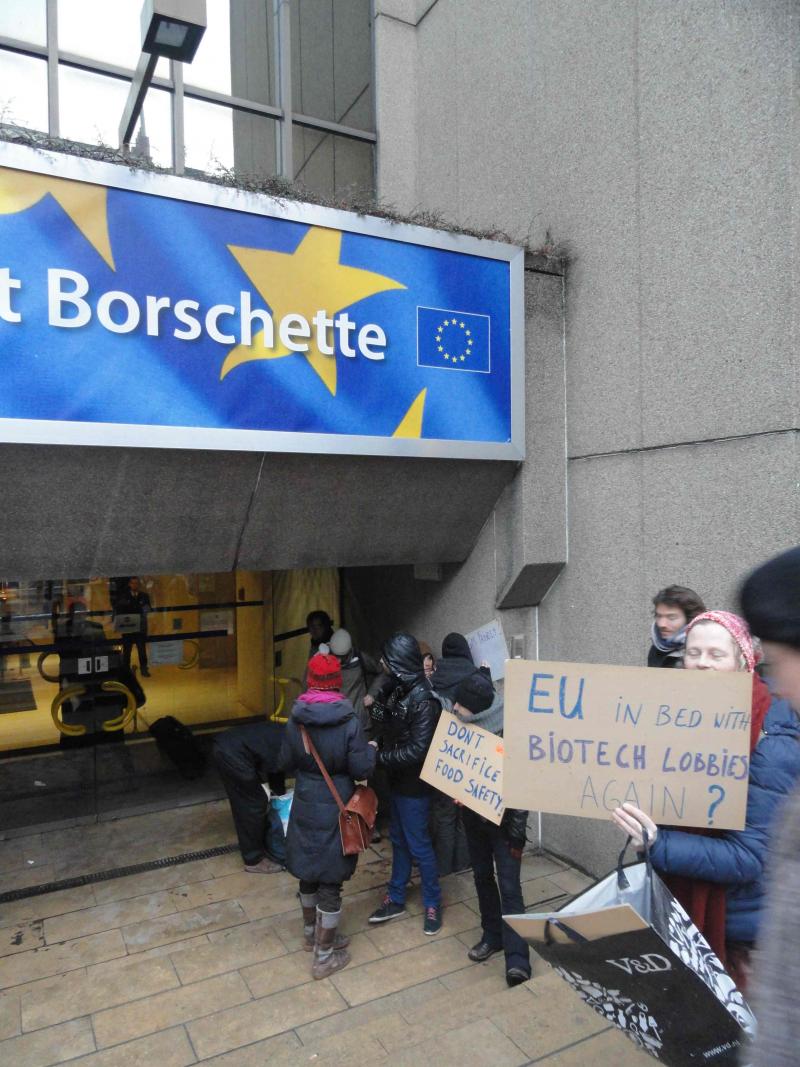
This morning, about 40 activists and concerned citizens handed out flyers to participants to a closed-doors meeting of the Standing Committee on the Food Chain and Animal Health (SCFCAH), gathering representatives of the European Commission and Member States in the Borschette conference centre, rue Froissard 36 in Brussels.

The meeting's agenda contained a key item: the draft regulation which, if voted today, would define how GMOs' harmfulness should be assessed in the EU. This regulation is based on EFSA guidelines which were written by scientists with conflicts of interests with industry: if voted today, the regulation would guarantee that risk assessment protocols used for GMOs risk assessment in the EU are unlikely to detect any undesired effect. The meeting comes at a strategic moment as GMOs risk assessment is one of the key items in the US-EU free trade talks due to be launched any moment soon.


Food and feed safety must be based on science, not on the interests of the biotechnology industry! 

  • Our health cannot be sacrified to free trade agreements and biotech industry interests
  • The draft regulation being discussed today lets “stacked events” off the hook and enshrines dodgy risk assessment protocols first drafted by scientists with conflicts of interests with industry
  • The 27 GM crops whose authorisation for cultivation in the EU is still pending would not even comply to the mandatory toxicology tests foreseen by this regulation; however, the text does not apply to them! 

Today's closed-doors meeting of the EU's Standing Committee on the Food Chain and Animal Health (SCFCAH), involving only officials of the European Commission and Member States, will deal with a crucial text: a regulation describing how the potential toxicity of GMOs should be assessed [1]. Based on EFSA guidelines written by scientists with conflicts of interests with the biotechnology industry [2] and vaguely improved by the Commission, the current draft regulation is flawed and will only make sure that risk assessment protocols used for GMOs risk assessment in the EU are unable to detect any undesired effect: studies on rats are only required to last 90 days (when recent studies indicated severe effects only appeared after at least a year, leading numerous scientists and national experts to call for longer studies than these industry-favoured 90 days[3]), and “stacked” crops (GM crops with several genetical modifications) are spared separate testing. 

But even though these protocols are flawed, they remain comparatively better than those used by industry to evaluate the 27 GM crops whose authorisation is currently pending in the EU system[4]. However, this regulation does not apply to these. Why such haste in deciding on useless food safety protocols? One answer could be free trade: the European Commission strongly pushes to sign a USA-EU free trade deal, hoping it will help the EU out of the ongoing crisis; but GMOs risk assessment is a key point in the debate5, because the US' GMOs risk assessment regime is even weaker than the EU's and the US do not want to risk undermining the interests of their biotech companies. 

However, we consider that sacrifying our health and our environment to short-term trade objectives and the irresponsible greed of biotech companies is not an option. 

1 Draft Commission implementing Regulation on implementing rules concerning applications for authorisation of genetically modified food and feed in accordance with Regulation (EC) No 1829/2003 of the European Parliament and of the Council and amending Regulations No (EC) 641/2004 and (EC) No 1981/2006. 

2 Led by ILSI scientist Harry Kuiper, see http://www.monsanto.no/index.php/en/environment/gmo/gmo-news/166-harry-k...  

3 Séralini's study on rats fed with Monsanto GM corn, also on the meeting's agenda, has been dismissed in a coordinated effort by EFSA and national food safety agencies; however, many independent scientists and strong minority opinions within Belgium, France and Germany's food safety agencies acknowledged the quality of the study's design and its relevance to the subject, calling for similar long-term studies. 

4 These studies' statistical power is way too low to enable any meaningful toxicity conclusion and would not even pass the weak requirements foreseen in the regulation. 

http://www.eubusiness.com/news-eu/us-economy-trade.mda 


Food and feed safety must be based on science, not on the interests of the biotechnology industry! Our health cannot be sacrified to free trade agreements and biotech industry interestsThe draft regulation being discussed today lets “stacked events” off the hook and enshrines dodgy risk assessment protocols first drafted by scientists with conflicts of interests with industryThe 27 GM crops whose authorisation for cultivation in the EU is still pending would not even comply to the mandatory toxicology tests foreseen by this regulation; however, the text does not apply to them! Today's closed-doors meeting of the EU's Standing Committee on the Food Chain and Animal Health (SCFCAH), involving only officials of the European Commission and Member States, will deal with a crucial text: a regulation describing how the potential toxicity of GMOs should be assessed [1]. Based on EFSA guidelines written by scientists with conflicts of interests with the biotechnology industry [2] and vaguely improved by the Commission, the current draft regulation is flawed and will only make sure that risk assessment protocols used for GMOs risk assessment in the EU are unable to detect any undesired effect: studies on rats are only required to last 90 days (when recent studies indicated severe effects only appeared after at least a year, leading numerous scientists and national experts to call for longer studies than these industry-favoured 90 days[3]), and “stacked” crops (GM crops with several genetical modifications) are spared separate testing. But even though these protocols are flawed, they remain comparatively better than those used by industry to evaluate the 27 GM crops whose authorisation is currently pending in the EU system[4]. However, this regulation does not apply to these. Why such haste in deciding on useless food safety protocols? One answer could be free trade: the European Commission strongly pushes to sign a USA-EU free trade deal, hoping it will help the EU out of the ongoing crisis; but GMOs risk assessment is a key point in the debate5, because the US' GMOs risk assessment regime is even weaker than the EU's and the US do not want to risk undermining the interests of their biotech companies. However, we consider that sacrifying our health and our environment to short-term trade objectives and the irresponsible greed of biotech companies is not an option. 1 Draft Commission implementing Regulation on implementing rules concerning applications for authorisation of genetically modified food and feed in accordance with Regulation (EC) No 1829/2003 of the European Parliament and of the Council and amending Regulations No (EC) 641/2004 and (EC) No 1981/2006. 2 Led by ILSI scientist Harry Kuiper, see http://www.monsanto.no/index.php/en/environment/gmo/gmo-news/166-harry-k...  3 Séralini's study on rats fed with Monsanto GM corn, also on the meeting's agenda, has been dismissed in a coordinated effort by EFSA and national food safety agencies; however, many independent scientists and strong minority opinions within Belgium, France and Germany's food safety agencies acknowledged the quality of the study's design and its relevance to the subject, calling for similar long-term studies. 4 These studies' statistical power is way too low to enable any meaningful toxicity conclusion and would not even pass the weak requirements foreseen in the regulation. 5 http://www.eubusiness.com/news-eu/us-economy-trade.mda    
 

Similar entries

Independence of EFSA's GMO risk assessment challenged

Munich/ Brussels, 21.3.2012 Testbiotech, supported by Corporate Observatory Europe (CEO), is today filing a new complaint with the EU Ombudsman questioning the independence of the chair of the panel of experts tasked with assessing the risk of new genetically engineered plants entering the European Union [1].

European Food Safety Authority admits failure on revolving doors

For the first time, the European Food Safety Authority (EFSA) has admitted that it did not take the necessary action to stop revolving doors. EFSA has stated that “regrettably” the authority did not follow up the relevant information. Further, the authority acknowledges that it has strengthened internal rules in response. 


Study on Monsanto's GM maize intensifies concerns about EFSA's reliability – Monsanto strikes back with PR offensive

Monsanto launched a PR offensive to try to spread doubt about a study published two days ago by French scientist Gilles-Éric Séralini: the study showed that the biotech giant's flagship herbicide, Roundup, and one the GM maizes produced by the firm, NK603, are having disastrous effects on rats' health when those are studied during their lifetime and not over the industry-favoured 90 days.

An open door for GMOs? – take action on the EU-US Free Trade Agreement

At the end of June, the European Union and the US will officially launch negotiations for a new free trade agreement known as the Transatlantic Trade and Investment Partnership (TTIP). The plan is to create the world's largest free trade area, 'protect' investment and harmonize regulation. While appealing to big business, the trade treaty poses a serious threat for citizens on both sides of the Atlantic, as it could weaken labour, social, environmental and consumer protection standards. One of the greatest risks includes US negotiators using the trade deal to push for the EU to open its plates and fields up to GM crops.

A decisive year for food safety in the EU? Campaign update

Not long after November's demonstration, EFSA took the initiative to organise a meeting in Brussels with the signatory organisations and the European Commission, in order to discuss the demands. This presented an interesting development in our dialogue with the EU institutions, which to date had seen then generally dismissing the very idea that there could be a problem in the EU food safety system. The meeting took place on 30 January.

Pages


The Brussels Business: Who runs the EU?

Corporate Europe Observatory

Corporate Europe Observatory (CEO) is a research and campaign group working to expose and challenge the privileged access and influence enjoyed by corporations and their lobby groups in EU policy making.

Read more

Creative Commons License
All content on this website is licensed under a Creative Commons Attribution-NonCommercial-ShareAlike 3.0 Unported License.
Corporate Europe Forum