
Corporate Europe Observatory

Exposing the power of corporate lobbying in the EU

What was discussed during Commissioner Rehn's meetings with Goldman Sachs? Euro Commissioner has a transparency problem.

  • Dansk
  • Nederlands
  • English
  • Français
  • Deutsch
  • Ελληνικά
  • Italiano
  • Portuguese
  • Español
  • Svenska
Printer-friendly versionSend by emailPDF version

Since the start of the eurocrisis, the European Commission has gained significant new powers to monitor and intervene in government budgets at a member-state level in the name of ‘economic governance’. At the same time, as a member of the Troika (with the International Monetary Fund and the European Central Bank), the Commission has prescribed controversial austerity and privatisation programmes for Greece, Portugal and Ireland. Many of these powers sit in the hands of the Commission’s Directorate-General for Economic and Financial Affairs (DG ECFIN) and Commissioner Olli Rehn. But power must be accountable. And while they’re more powerful than ever, their appetite for transparency appears very limited.

In February this year I set out to find out more about who Commissioner Rehn has been consulting with about the Commission’s eurocrisis policies, including the Troika programmes. I submitted an online request for access to all the correspondence and minutes of meetings between Commissioner Rehn, his cabinet and DG ECFIN staff and private sector companies and lobby groups. The EU’s transparency regulation gives the Commission three weeks to reply to such requests, but it took three months and several reminders before I got a very limited response. This provided short notes of a small number of meetings between the Troika and banks and companies in Ireland. There was nothing about Greece or Portugal, or about meetings outside the context of the Troika.

I asked the Commission to do another search covering the full range of documents I had requested. Another three months later – and after several further reminders – I finally received an envelope with 44 documents, relating to Rehn and his cabinet. The Commission said a response from DG ECFIN would follow. Five weeks later this still hasn’t arrived.

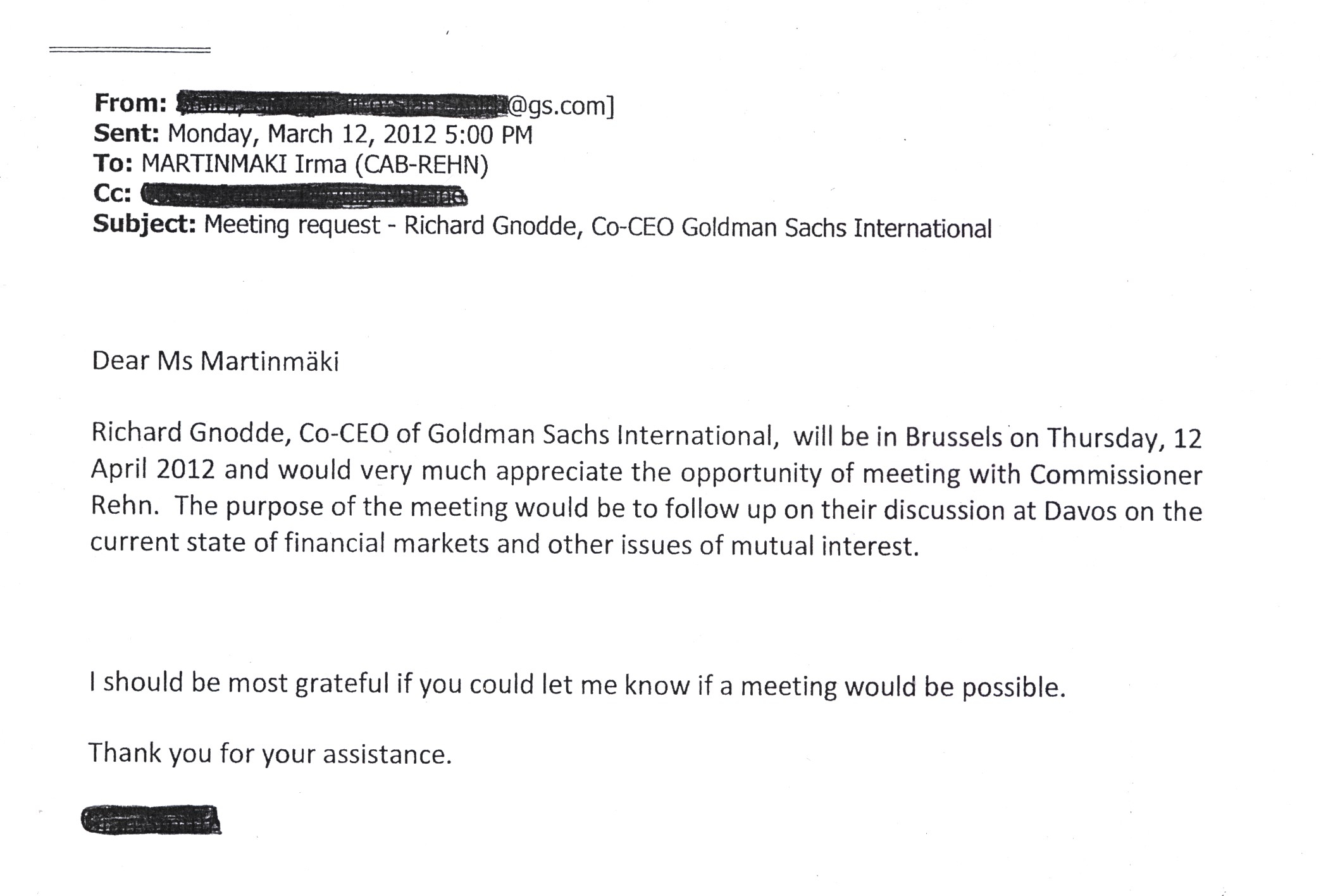
Forty four documents might sound like a lot, but 43 of these concerned correspondence about companies and lobby groups wanting to meet with Rehn. These included Goldman Sachs, KBC, BBVA, Moody’s and Mason Capital Management, as well as the European Banking Federation. There was only one letter of substance (from the trade union federation ETUC expressing its concerns about the Troika imposing harsh austerity measures), but no reply from Rehn. Didn’t Rehn receive any other letters about the EU’s policies on the crisis? There was at least one from NGOs (co-signed by Corporate Europe Observatory) about privatisation imposed by the Troika on Greece and Portugal. Four months later, the NGOs are still waiting for a response.

Apart from the missing documents, there are two other big problems with the 43 emails and letters released by Rehn’s cabinet. Firstly, many names of lobbyists are crossed out with a thick black pen. The Commissions claims that crossing out these names is “compliant with the rules on personal data protection”. But those who asked for meetings with Vice-President Rehn did not do this in a personal capacity, but as employed staff of companies or lobby groups aiming to influence EU decision-making. There is therefore no justification for keeping these names secret. Secondly, the Commission states that “no minutes were drafted for any of these meetings” with lobbyists. Rehn appears to have had at least three meetings during the last 12 months with Goldman Sachs’ heavyweights such as Lloyd Blankfein and Richard Gnodde. Yet no notes were taken? At other Commission DGs, such as DG Trade, note-taking is standard procedure, so it would be rather unusual if this was the case.
This whole experience suggests that transparency is not a priority for Commissioner Rehn or for DG ECFIN. Inadequate, delayed responses to requests for access to documents is a violation of the EU’s Regulation 1049/2001. The Commission, not least in the light of the new powers it has gained, should fully respect its own rules – and it should do more than that.

Commissioner Rehn’s website does not list his meetings (there is only a diary for that particular week). It is high time the European Commission embraced a policy of pro-active transparency by posting lists of meetings with lobbyists on its website. This would be a crucial step towards securing the citizens’ right to know. It would also save watchdogs, journalists and others engaging in access-to-documents requests, as well as the Commission itself, a lot of time and energy. The UK Government has been doing this for several years: a list of meetings with lobbyists is made available per government department, updated quarterly.

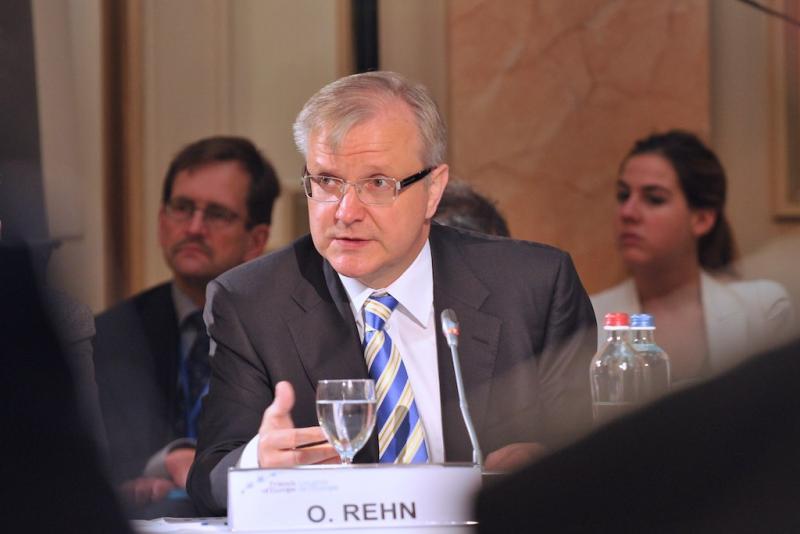
Photo Rehn © Friends of Europe

In February this year I set out to find out more about who Commissioner Rehn has been consulting with about the Commission’s eurocrisis policies, including the Troika programmes. I submitted an online request for access to all the correspondence and minutes of meetings between Commissioner Rehn, his cabinet and DG ECFIN staff and private sector companies and lobby groups. The EU’s transparency regulation gives the Commission three weeks to reply to such requests, but it took three months and several reminders before I got a very limited response. This provided short notes of a small number of meetings between the Troika and banks and companies in Ireland. There was nothing about Greece or Portugal, or about meetings outside the context of the Troika.I asked the Commission to do another search covering the full range of documents I had requested. Another three months later – and after several further reminders – I finally received an envelope with 44 documents, relating to Rehn and his cabinet. The Commission said a response from DG ECFIN would follow. Five weeks later this still hasn’t arrived.Forty four documents might sound like a lot, but 43 of these concerned correspondence about companies and lobby groups wanting to meet with Rehn. These included Goldman Sachs, KBC, BBVA, Moody’s and Mason Capital Management, as well as the European Banking Federation. There was only one letter of substance (from the trade union federation ETUC expressing its concerns about the Troika imposing harsh austerity measures), but no reply from Rehn. Didn’t Rehn receive any other letters about the EU’s policies on the crisis? There was at least one from NGOs (co-signed by Corporate Europe Observatory) about privatisation imposed by the Troika on Greece and Portugal. Four months later, the NGOs are still waiting for a response.Apart from the missing documents, there are two other big problems with the 43 emails and letters released by Rehn’s cabinet. Firstly, many names of lobbyists are crossed out with a thick black pen. The Commissions claims that crossing out these names is “compliant with the rules on personal data protection”. But those who asked for meetings with Vice-President Rehn did not do this in a personal capacity, but as employed staff of companies or lobby groups aiming to influence EU decision-making. There is therefore no justification for keeping these names secret. Secondly, the Commission states that “no minutes were drafted for any of these meetings” with lobbyists. Rehn appears to have had at least three meetings during the last 12 months with Goldman Sachs’ heavyweights such as Lloyd Blankfein and Richard Gnodde. Yet no notes were taken? At other Commission DGs, such as DG Trade, note-taking is standard procedure, so it would be rather unusual if this was the case.This whole experience suggests that transparency is not a priority for Commissioner Rehn or for DG ECFIN. Inadequate, delayed responses to requests for access to documents is a violation of the EU’s Regulation 1049/2001. The Commission, not least in the light of the new powers it has gained, should fully respect its own rules – and it should do more than that.Commissioner Rehn’s website does not list his meetings (there is only a diary for that particular week). It is high time the European Commission embraced a policy of pro-active transparency by posting lists of meetings with lobbyists on its website. This would be a crucial step towards securing the citizens’ right to know. It would also save watchdogs, journalists and others engaging in access-to-documents requests, as well as the Commission itself, a lot of time and energy. The UK Government has been doing this for several years: a list of meetings with lobbyists is made available per government department, updated quarterly.Photo Rehn © Friends of Europe
 

Similar entries

MEP meetings with lobbyists - transparency ahead?

Sweden is known as a global leader in transparency, but among centre-right Swedish MEPs there’s very little enthusiasm for being open about their contacts with lobbyists, as a survey published on europaportalen.se found.

Commission gives a warm welcome to unregistered lobbyists: Dalli not alone in ignoring transparency

Ex-Commissioner John Dalli knowingly met with lobbyists who were not registered in the European Commission and European Parliament’s Transparency Register. Lobbyists who choose to hide from the public who they're lobbying for, on what subject, or how much money they’re spending to influence public policy. Lobbyists who work in the shadows. Shocking? Yes, but it is a very common practice in the Commission to meet with unregistered lobbyists, a sure-fire indicator that despite what it says, the Commission is not really concerned about lobby transparency.

Ombudsman rejects Commission secrecy over business lobbyists' names

In October 2005, Corporate Europe Observatory, an Amsterdam-based lobby watchdog, submitted a complaint against the European Commission after Directorate-General Trade – led by Peter Mandelson – had started blanking out the names of industry lobbyists in correspondence, minutes of meetings and other documents released under EU access to document rules.On 11 October 2005 Corporate Europe Observatory filed a complaint to the European Ombudsman (complaint 3269/2005/TN) about the European Commission’s blanking out of the names of industry lobbyists in documents to which access had been provid

Revealed: EU's revolving door facilitates tobacco lobby meetings

While leaving most issues unclear, the Commission’s response to Parliamentary questions about Dalligate has revealed some disturbing new facts. Behind closed doors meetings with tobacco lobbyists are facilitated by the revolving door – when former public officials become lobbyists, often in the same policy areas.

Health and transparency NGOs demand Commission implements UN tobacco lobbying rules

Transparency, public health and tobacco control NGOs have today written to EU Commission President Barroso to complain about Commission officials having undisclosed meetings with tobacco lobbyists, in violation of UN rules. The undisclosed meetings are particularly controversial in the context of the Dalligate tobacco lobbying scandal, which led to the resignation of Commissioner Dalli under unclear and contested circumstances.

Pages


The Brussels Business: Who runs the EU?

Corporate Europe Observatory

Corporate Europe Observatory (CEO) is a research and campaign group working to expose and challenge the privileged access and influence enjoyed by corporations and their lobby groups in EU policy making.

Read more

Creative Commons License
All content on this website is licensed under a Creative Commons Attribution-NonCommercial-ShareAlike 3.0 Unported License.
Corporate Europe Forum