Corporate Europe Observatory

Exposing the power of corporate lobbying in the EU

Commission in court over privileged access for business in EU-India free trade talks

  • Dansk
  • Nederlands
  • English
  • Français
  • Deutsch
  • Ελληνικά
  • Italiano
  • Portuguese
  • Español
  • Svenska
December 11th 2012
Printer-friendly versionSend by emailPDF version

Oral hearing scheduled in Luxembourg.

The EU's General Court has announced a date for the hearing for Corporate Europe Observatory's legal action, suing the EU Commission for withholding information related to the EU’s free trade talks with India. The Commission is accused of discriminating in favour of corporate lobby groups and of violating the EU’s transparency rules. The case will be heard in Luxembourg on 11 January 2013.

The lawsuit (T-93/11) concerns 17 documents related to the ongoing EU-India free trade negotiations. The Commission shared all of these documents in full with corporate lobby groups such as BusinessEurope. But Corporate Europe Observatory only received censored versions, with allegedly sensitive information about priorities, tactics and strategies in the negotiations deleted. The Commission argued that the public disclosure of these documents would negatively affect relations with India.

But how can documents that the Commission has already shared with the business community at large suddenly become confidential and a threat to the EU’s international relations when a public interest group asks for their disclosure? This is the core question raised by the lawsuit.

What is at stake

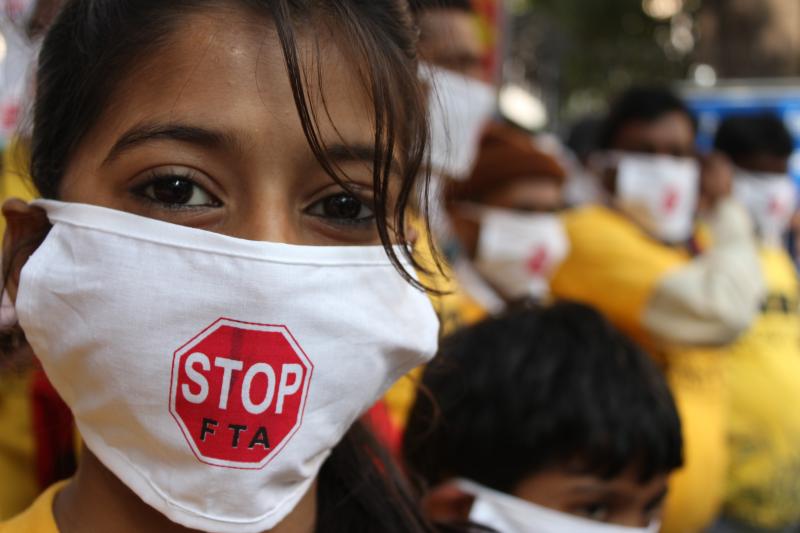
The case comes to court as the EU and India are speeding up negotiations on a far-ranging free trade agreement, which they want to conclude in the first half of 2013. The talks, which started in 2007, have been shrouded in secrecy, with no text or position as yet disclosed to the public. Yet, there are major concerns prompted by the scant information that has emerged that the EU-India FTA will in fact fuel poverty, inequality and environmental destruction. And that the EU Commission and the Indian government have effectively handed the negotiating agenda over to big business (watch the video Trade Invaders).

What is at stake in the lawsuit is whether the Commission can continue its habit of granting big business privileged access to its trade policy-making process by sharing information that is withheld from the public. This practice not only hampers well-informed and meaningful public participation in EU trade policy-making, it also leads to a trade policy that, while catering for big business needs, is harmful to people and the environment in the EU and the world.

A ruling will not be expected for several months.

Read about the case in detail:


The lawsuit (T-93/11) concerns 17 documents related to the ongoing EU-India free trade negotiations. The Commission shared all of these documents in full with corporate lobby groups such as BusinessEurope. But Corporate Europe Observatory only received censored versions, with allegedly sensitive information about priorities, tactics and strategies in the negotiations deleted. The Commission argued that the public disclosure of these documents would negatively affect relations with India.But how can documents that the Commission has already shared with the business community at large suddenly become confidential and a threat to the EU’s international relations when a public interest group asks for their disclosure? This is the core question raised by the lawsuit.What is at stakeThe case comes to court as the EU and India are speeding up negotiations on a far-ranging free trade agreement, which they want to conclude in the first half of 2013. The talks, which started in 2007, have been shrouded in secrecy, with no text or position as yet disclosed to the public. Yet, there are major concerns prompted by the scant information that has emerged that the EU-India FTA will in fact fuel poverty, inequality and environmental destruction. And that the EU Commission and the Indian government have effectively handed the negotiating agenda over to big business (watch the video Trade Invaders).What is at stake in the lawsuit is whether the Commission can continue its habit of granting big business privileged access to its trade policy-making process by sharing information that is withheld from the public. This practice not only hampers well-informed and meaningful public participation in EU trade policy-making, it also leads to a trade policy that, while catering for big business needs, is harmful to people and the environment in the EU and the world.A ruling will not be expected for several months.Read about the case in detail: 
 
To prevent automated spam submissions leave this field empty.

Plain text

  • No HTML tags allowed.
  • Web page addresses and e-mail addresses turn into links automatically.
  • Lines and paragraphs break automatically.

Similar entries

Court ruling over privileged access for business in EU-India free trade talks

The EU's General Court has announced a date for the judgement in Corporate Europe Observatory's legal action, suing the European Commission for withholding information related to the EU’s free trade talks with India. The Commission is accused of discriminating in favour of corporate lobby groups and of violating the EU’s transparency rules. The judgement will be delivered on 7 June 2013.

EU-India Trade Invaders - How big business is driving the EU-India free trade negotiations

A new joint report from Corporate Europe Observatory and India FDI Watch reveals how, in the negotiations for a trade deal between the EU and India, the EU Commission and the Indian government have handed the agenda over to corporate lobby groups. This big-business-first agenda will put at risk the livelihoods of millions of small farmers, street traders and patients. The report shows how negotiators on both sides have entered into a symbiotic working relationship with big corporations and their lobby groups. It shines a light on the dense web of corporate advisory bodies, working groups and secret consultation channels through which business can exercise undue influence over trade-policy making in the EU and India. And it explains the human consequences of the corporate trade agenda in fields such as intellectual property rights, retail, agriculture and manufacturing.

Commission defends privileged access for big business in court

In an oral hearing at the EU's General Court in Luxembourg on Friday, 11 January 2013, the EU Commission defended its practice of sharing sensitive information with big business lobby groups while withholding the same information from the general public. The hearing took place in the context of Corporate Europe’s Observatory’s lawsuit, suing the EU Commission for withholding information related to the EU’s free trade talks with India.

EU-India Trade Talks Must Stop

Civil society groups today urged the European Commission and Indian Government to halt free trade negotiations, scheduled to continue in Delhi tomorrow. In an open letter, signed by more than 100 groups, they warned that the talks would damage the livelihoods of millions of people in both India and Europe, exacerbating poverty and undermining economic and social development.

DG Trade: No apologies for giving privileged access to business

During one of DG Trade's recent meetings with civil society, I raised CEO's concerns about the privileged access given to big business interests by the Commission when developing trade policy. The reply from Director General, David O'Sullivan, was surprisingly frank.

Pages


The Brussels Business: Who runs the EU?

Corporate Europe Observatory

Corporate Europe Observatory (CEO) is a research and campaign group working to expose and challenge the privileged access and influence enjoyed by corporations and their lobby groups in EU policy making.

Read more

Creative Commons License
All content on this website is licensed under a Creative Commons Attribution-NonCommercial-ShareAlike 3.0 Unported License.
Corporate Europe Forum